
Cascade Legends
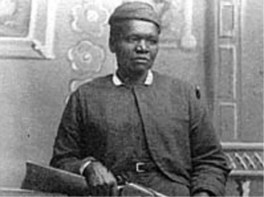
Mary Fields
One of the most colorful characters of St. Peter’s Mission and Cascade was Mary Fields, protégé of Mother Amadeus, Superior of the Ursuline Order at St. Peter’s Mission. Mary came to Montana in 1885 to care for the seriously ill nun. She had met Mother Amadeus when, after their mother died, she brought the children of Judge Edmund Dunne, brother of Mother Amadeus, to the Ursuline Convent at Toledo, Ohio. As there was deep affection between the two, Mary remained at the Mission after the recovery of Mother Amadeus to assist her.
Mary was born a slave in Hickman County, Tennessee. It is believed she was born in 1832, and she celebrated March 15 as her birthdate. Receiving her freedom after the Civil War, Mary worked at various jobs along the Mississippi River. One exciting occurrence of her life, that she loved to tell about, was the race between the great Mississippi riverboat, the Robert E. Lee, and the steamer Natchez. She was chambermaid on the Robert E. Lee and it won the race but in order for them to do so they had to build up a lot of steam. Mary said, “They throw’d everything but the kitchen sink in that fire and it was so hot, we’uns figured it was about to bust!”
Mary lived for approximately ten years at the Mission assisting the sisters in every way possible, but because of her terrible temper, rough ways and the many complaints to the Bishop by those who were unlucky enough to arouse her wrath; she was ordered to leave. Mother Amadeus wasn’t there a great deal of the time as it was necessary for her to oversee the other Missions in the northwest. She, therefore, was unable to control Mary who would have done anything for Mother Amadeus. Broken-hearted, Mary moved to Cascade where with Mother Amadeus’ help she opened a restaurant. Twice this failed due to the goodness of her heart in extending credit. Finally Mother Amadeus requested she be given the mail route to the Mission. From that time on until old age forced her retirement, the mail went out. Mary met every train and if her wagon could not get through she would walk. She did this for eight years.
Upon her retirement from the mail route, Mary opened a laundry in her home which was located in the vicinity of the Methodist Church in Cascade. When this building burned down, the people of Cascade built her another home. Mary, for all her toughness, swearing and terrible temper, was much beloved by the people of Cascade. She was mascot of the baseball team, school would be closed on her birthday so that she could treat the children in celebration and she was welcome in any home where she baby-sat many of the children. She was a very large woman, weighing over two hundred pounds and her face was “as black as burnt over prairie.” She always wore a man’s cap, shoes and overcoat and smoked a large cigar or pipe. She loved a “nip” at the local saloons. It almost broke her heart when a ruling was passed that women would not be allowed in the saloons, so when D.W. Munroe was elected mayor and he rescinded that ruling, he won a friend for life.
Mary was active up to the last week or so of her life. When she became ill the people of Cascade made arrangements for her to be taken to the Columbus Hospital in Great Falls. She died there December 5, 1914. Funeral services were held in the Pastime Theatre (there was no Catholic Church in town at the time) and the Reverend John J. Casey of St. Peer’s Mission conducted the services. According to the Cascade Courier of December 11, 1914, it was one of the largest funerals ever held in Cascade as friends from far and near came to pay their respects. Mary is buried in the Hillside Cemetery at Cascade.
By Sister Genevieve
Gary Cooper wrote an article for Ebony magazine saying, “born a slave somewhere in Tennessee, Mary lived to become one of the freest souls ever to draw a breath.”
 Use your library often for Education, Information, Recreation, and Technology